
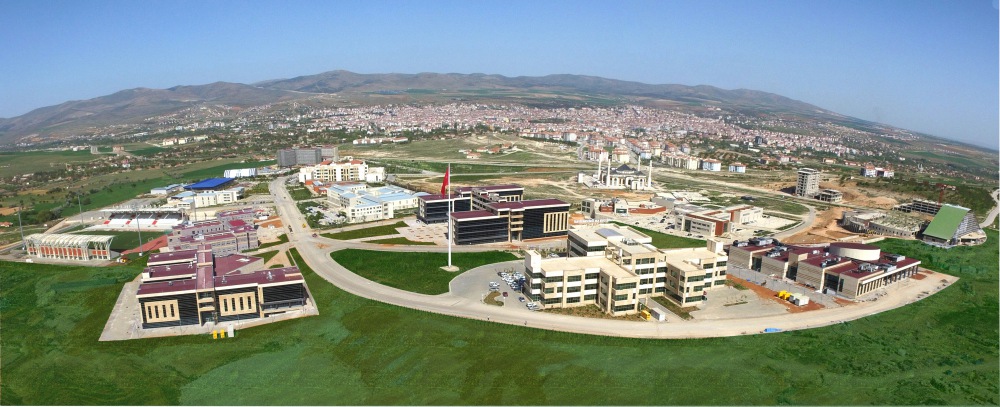
Kırşehir Ahi Evran University was established in 2006. The university provides education in 5 campuses and has 10 Faculties, 3 Institutes, 3 Schools, 3 Colleges, 7 Vocational Schools, 22 Research and Application Centers. 1036 academic staff provides education to approximately 20.000 students. Computer Sciences Application and Research Center, Continuing Education Application and Research Center, Environmental Problems Application and Research Center, Distance Education Application and Research Center, Psychological Counseling and Guidance Application and Research are some of the research centers.
The mission of the university is to educate qualified people who have adopted national and
universal values and have the technical and human skills required by the age; to contribute to the development of the region and the country with the researches it conducts and the quality systems it develops based on cooperation with stakeholders and continuous improvement. In this context, it aims to be a university based on continuous improvement and stakeholder
satisfaction, prioritizing regional development and specialization, conducting research at national and international level, preferred by qualified students, and taken as a model with the education and quality management systems it has developed.The education and training policy at our university aims to provide vocational and technical skills and this process is carried
out in line with predetermined competencies with a competency-based education approach. Within the scope of education policies, a student- centered approach is adopted in terms of gaining professional skills and an inclusive approach is adopted in terms of providing equal opportunities to all students. In addition, additional services are provided to disadvantaged groups to support their development. Our university adopts a competency-based quality assurance system in education and training processes. In this context, the “Ahi competency-Based Education Portal” (AYDEP) developed by our University is used effectively in face-to-face and distance education processes. Depending on the conditions in education and training processes, face-to-face and distance education models are adopted to be used together.
Our university has a strong technological infrastructure that enables the planning, implementation and evaluation of distance education processes. The university, which is based on the higher education quality assurance system, fulfills national and international quality management system standards, adopts continuous improvement and innovative approaches, is to develop and implement quality management models. Our university was awarded 5 stars in the EFQM Model Superior Performance Competency Assessment. The EFQM Model helps you achieve success by measuring where you are in the journey of creating sustainable value in organizations. It will empower you to move forward and significantly improve the performance of organizations while helping you understand the difference and the possible solutions that exist. In order to have strong relationships with international institutions, AEU Foreign Affairs Office began its studies in 2006. The Office has participated in different types of EU projects, up to now. In order to achieve the goals of AEU, student-faculty exchange and scientific projects; 1) realizes industry cooperation, 2) raises the quality of education in our university by joining the study groups in cooperation with the European Union, 3) supports the social, economic, and cultural improvement of the region. In AEU, especially international projects are supported and extensive resources are provided for such projects. Quality and R&D studies carried out in the university have increased the importance given to international projects.
AEU adopts the principle of environmental awareness, circular economy policy, research and development policy, socialcont ribution policy, internationalization policy while determining its educational policies. Depending on the principle of environmental awareness, our university aims to contribute to the fight against global warming and climate change through the protection and improvement of the environment within the scope of relevant legal obligations and other compliance criteria. It adopts the efficient use of energy, the dissemination of waste recovery activities, and raising awareness about energy efficiency and the environment as a principle. Within the scope of the circular economy policy of AEU waste management is implemented on its campuses, there are guidelines and instructions for managing waste, and it encourages
its stakeholders and employees in its ecosystem to recycle, solid waste disposal, composting of food and greenhouse wastes, water reuse and conservation, and prevention of waste. Our university, which adopts the principle of environmental sensitivity (nature conservation, land use, afforestation), supports studies to minimize the carbon footprint by adopting it as a culture, and in all units of our university, the approach of making purchases in a way that saves energy in the purchasing process, suitable for reuse to prevent waste, compostable, water and energy efficient, and efficient use of resources has been adopted. Our university is based on a livable Environment and Energy Policy by considering the society and the environment.